

CIO Note: Is there a better way to handle distributions?
Volatility of annual distributions can create real challenges for advisers seeking to straddle managing client cash flows and optimising investment outcomes. The occurrence of larger distributions in recent years has highlighted the challenge for adviser strategy in dealing with variability in distributions, while posing a range of questions for how to deal with anticipated annual cashflows where the outcome is unknown.
Advisers play a critical role in deciding how best to deal with distributions, and this paper does not seek to influence that decision but rather help to inform the strategy. It offers an investment lens on dealing with the challenges that arise from the variability of cash distributions and the potential client impact of different strategies, which we hope will add value to your conversations with clients.
Key Takeaways
- Distributions are a variable outcome of portfolio income and realised gains over a given period. These can be highly variable depending on a range of factors including dividends paid by underlying investments, portfolio turnover, and capital gains on realised assets.
- Distribution unpredictability can introduce risk to income strategies. Using distributions as a material contribution to a client’s income source is unpredictable from a timing and size perspective.
- The cash drag on returns from distributions can be real and material. Taking outsized distributions in cash without reinvesting can materially reduce total wealth from the opportunity cost of lost compounding.
- The cash distribution can unintendedly de-risk the portfolio. When withdrawals are funded from distributions, the total portfolio allocation drifts toward a more conservative strategy.
- Structured alternative options to a cash distribution reduces the risk of unintended outcomes. A systematic withdrawal, a cash reserve (bucket) strategy not sized from distributions, or a smoothed drawdown rule produces higher long-term wealth and can solve many challenges such as income reliability and unintended changes to the risk profile.
- Reinvestment of distributions coupled with a deliberate cash strategy should be the default approach to reduce unintended risk. Where a genuine liquidity need exists, meet it with a separate, deliberate withdrawal.
Outlining the Challenge
A distribution is an investor’s share of the income and realised gains a fund has earned over a period, paid out in proportion to the units they hold. It typically includes dividends and interest earned on the fund’s holdings, plus net realised capital gains from positions sold during the period.
Distributions can be received as:
- Cash paid into a nominated bank account; or
- Reinvested, where new units are issued at the ex-distribution price.
What clients use distributions for. Some clients elect cash simply for the flexibility to decide whether to reinvest at the time of payment. Others, particularly in pension phase, use distributions to fund liquidity needs where their own cash holdings are insufficient post-retirement. Either way, the distribution ends up setting the client’s income and asset allocation.
The issue this creates. Distributions are not a reliable or controllable income stream and treating them as one can introduce unintended risks to a client’s wealth, their risk profile, and the stability of their income.
This note sets out why distributions are volatile, what that means for client outcomes, and the right way to reduce unintended risk.
Why are distributions sometimes volatile?
Realised capital gains are what vary most from year to year. Some years a fund crystallises significant gains; or prior-year losses can absorb gains before they ever reach the investor. Market conditions, portfolio turnover, and the timing of sales all feed into this. Importantly, it sits outside the client’s control or expectation.
Distributions are also infrequent relative to how clients prefer to receive income. Most are paid semi-annually or annually rather than monthly, and the full amount converts to cash (or is reinvested) on a single date. That is dollar-cost averaging in reverse: one date (rather than a spread of them) decides whether the client caught a good day or a bad one.
The true cost of taking cash distributions is ‘unintended outcomes’
The cash drag reduces long term returns. When a distribution is taken as cash rather than reinvested, the units aren’t repurchased, so the client permanently loses the compounding benefit on that capital. This can create a meaningful loss in wealth from the lost compounding effect without a change in the underlying strategy.
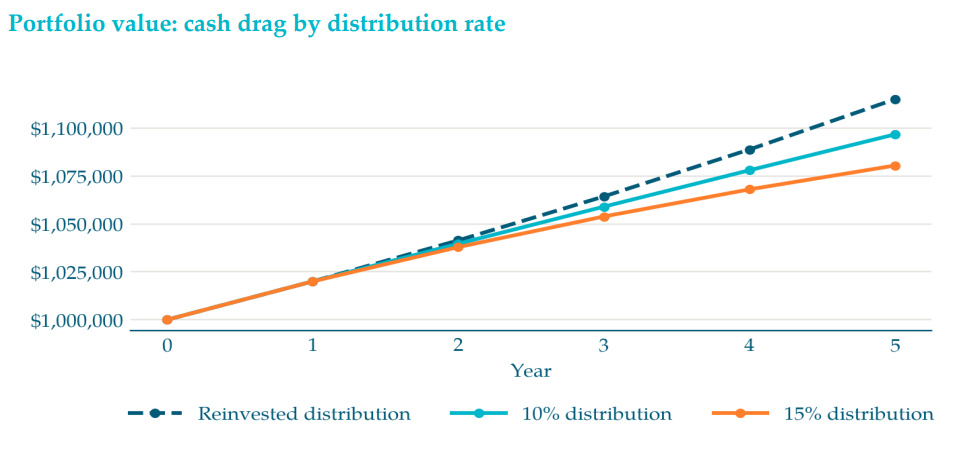
The chart below models portfolio value over 5 years for a $1,000,000 diversified portfolio, at various distribution rates. Each year, a fixed $50,000 of the distribution is assumed to be spent and the remainder held as cash. The gap between the dashed (reinvested) line and the solid lines is the cost of not reinvesting. This gap widens over time and is greater the higher the distribution rate.
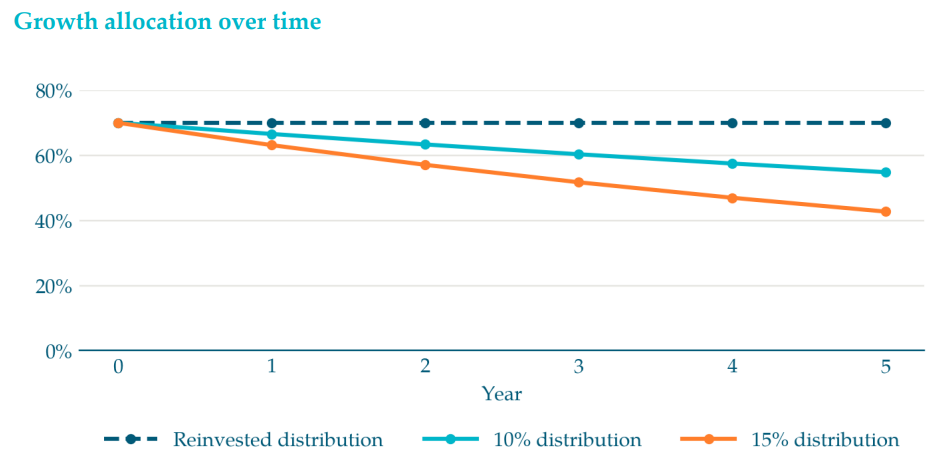
It creates an unintended drift in asset allocation. Taking distributions in cash changes the risk profile of the portfolio. The chart below assumes the same diversified portfolio, with the same $50,000 of each distribution spent and the remainder held as cash. As that cash accumulates, the growth allocation steadily erodes and changes the client’s risk profile by default.
Distribution volatility makes cash an unreliable income source. Distributions can vary materially year to year depending on capital activity, income realised, and market conditions. Using distributions directly as a liquidity mechanism exposes the client’s cash flow to that volatility.
It is a reactive approach to liquidity management. Taking distributions in cash outsources the timing and amount of the drawdown decision to the distribution, rather than sizing withdrawals to the actual spending need.
The Right Approach: Reinvest by Default, Meet Liquidity Needs Separately
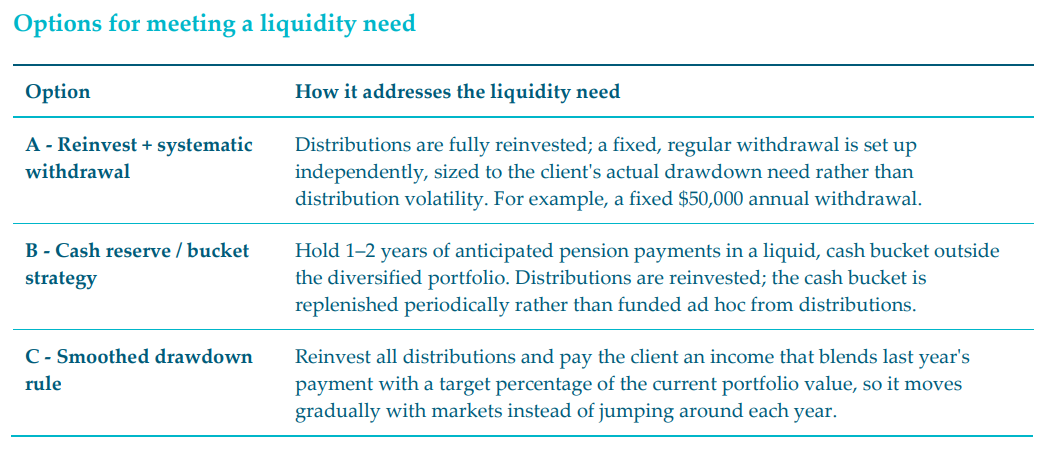
For pension-phase clients, or those who value flexibility, the goal should be to decouple the liquidity decision from the distribution decision. Reinvestment should be the default; withdrawals should be a sized, deliberate, separate instruction.
The cost of choosing cash
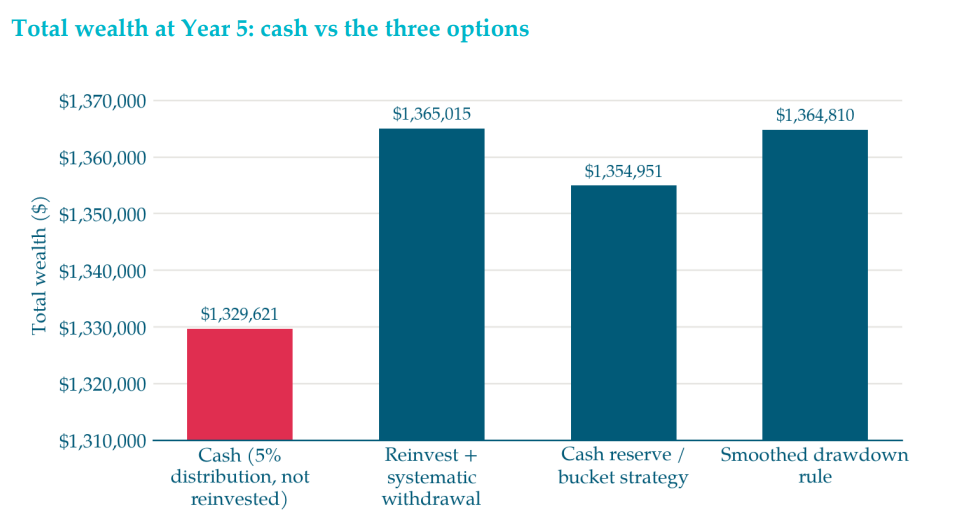
Using the same initial portfolio of $1,000,000, the following chart compares the accumulated wealth at the end of 5 years when the distribution is taken as cash versus one of the options outlined above. All three alternatives outperform simply taking the distribution in cash both in the total wealth and in preserving the intended risk profile.
Conclusion
Taking distributions in cash carries a real cost: lost compounding, an unmanaged drift, and exposure to distributions that may be volatile in both timing and size.
Reinvestment of distributions avoids all these issues. Where a liquidity need exists, a systematic withdrawal, a cash reserve or a smoothed drawdown rule produces a better long-term outcome.
The options modelled delivers a more targeted strategy, with more stable income and higher long-term wealth for your client, all achieved without changing the intended risk profile.