

CIO Note: The ground is shifting
Several of the conditions that markets have relied on for years are changing, creating the need for a different approach.
For advised clients or wholesale clients only.
Ask most investors whether their portfolio is diversified and they will say yes. They own hundreds of companies across dozens of countries, an allocation to government bonds, some property and a few alternatives. On paper it looks well diversified. The important question is how it would actually hold up if markets fell. Looking diversified and being diversified are not always the same thing.
Early this year, when the conflict between the United States, Israel and Iran escalated, shares sold off, as many would expect. What diversified investors did not expect was that the assets meant to cushion the fall let them down at the same moment. Bonds and gold fell alongside shares, and the US dollar did not provide its usual reserve-currency buffer. The safety net had holes in it, and they appeared exactly when it was needed.
This was not bad luck. Several of the core foundations that a traditional diversified approach has rested on for decades are being challenged, by a mix of cyclical and structural forces that call for an evolved approach.
The market regime has shifted to one of higher and more variable inflation, heavier government debt and less central-bank support. In that world, owning more is not the same as owning different, bonds no longer hedge on autopilot, and the global equity index has itself become a concentrated bet on a handful of very large companies. Genuine diversification, the approach we have always taken, is what answers this. The rest of this note takes each point in turn, and how we are positioned.
The foundations are changing
For the better part of thirty years, investing rested on a set of stable conditions. Inflation was low and predictable. Central banks could be relied on to cut rates and add liquidity whenever markets wobbled, the reflex that became known as the central bank put.
Bonds usually rose when shares fell. The US dollar was the safe asset in a crisis. Active managers could add value, and quality companies typically outperformed in a downturn. None of these were laws of nature; they were features of a particular era that, for now, has ended.
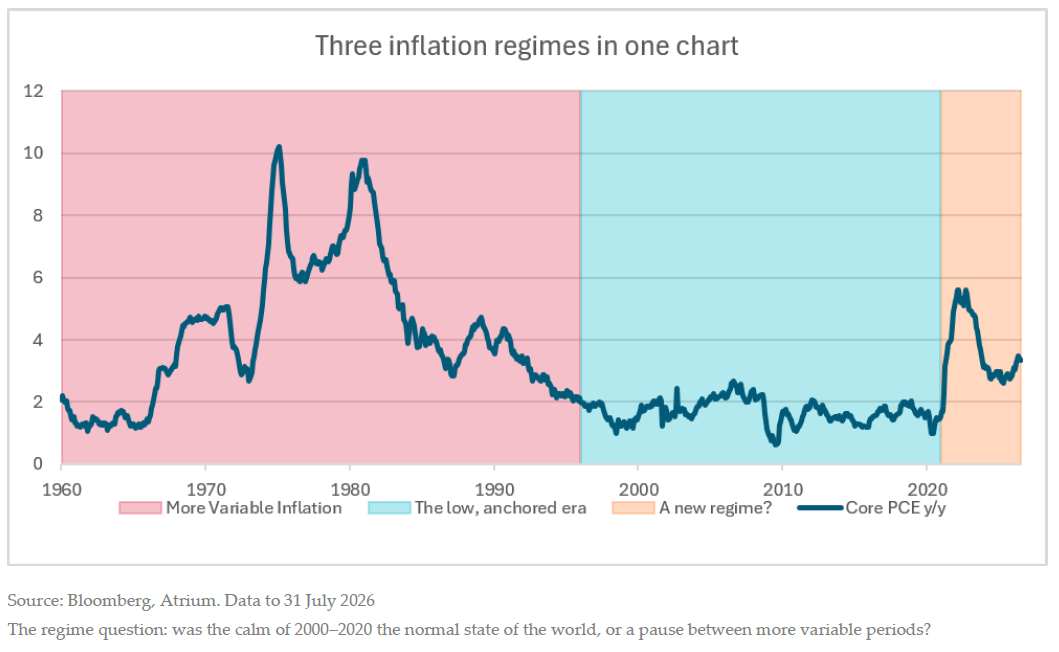
Assessing inflation helps outline the shift. From 2000 to 2020, US inflation averaged close to 2% and barely moved (1% swings). In the four decades before that it averaged ~4.5% and swung sharply. Since 2021 it has broken out again, and the stable, low-inflation (and interest rate) period that shaped a generation of portfolios now looks like the exception, not the rule.
The rest of the scaffolding is moving with it.
- Having held rates near zero and printed money after the financial crisis, central banks raised rates at the fastest pace in a generation once inflation returned and are now far less able to rescue markets when they fall.
- Governments are running large deficits that add to the pressure on inflation and bonds. Even the US dollar has looked less dependable, weakening through the “Liberation Day” tariff turmoil of 2025 when in past crises it would have rallied, while central banks accumulate gold at a pace not seen in decades.
- Inside portfolios, active managers have found it harder to beat the index, and bonds have proved a conditional hedge rather than a guaranteed one.
The ground a traditional diversified portfolio stands on has become less reliable, and the approach must respond.
Diversification is being purposeful about what you own
Diversification is not just a numbers game. Owning more things is not the same as owning things that behave differently when it matters. Consider a portfolio spread across global shares, corporate bonds, listed property, infrastructure and private equity. It looks diversified but strip away the labels and most of those exposures are driven by the same factor exposure: interest rates.
When interest rates rise sharply or risk appetite turns, they move together. In 2022, shares, bonds, listed property and credit fell at once, because that single dominant factor, sharply higher interest rates, worked against all of them. Different labels, the same driver.
We refer to this as naïve diversification: many holdings driven by a single or narrow set of factors.
Genuine diversification is the opposite, holding return streams driven by genuinely different factors, so that when one comes under pressure the others are not exposed to the same force. It is a core objective for any portfolio built to withstand market and economic cycles.
Bonds: the airbag that only deploys in some crashes
Think of the bonds in a diversified portfolio as an airbag. For most of the past two decades it worked: when shares fell, bonds rose, and the 60/40 portfolio earned its reputation. But a bond airbag only deploys in one type of crash. It works when the shock is about growth, when the economy weakens, inflation is low, and central banks cut rates. It does not work when the shock is about inflation, because the very thing hurting shares, higher prices and rates, also drives bond prices down. Both fall together. 2022 was a stark reminder, and this year’s conflict another.
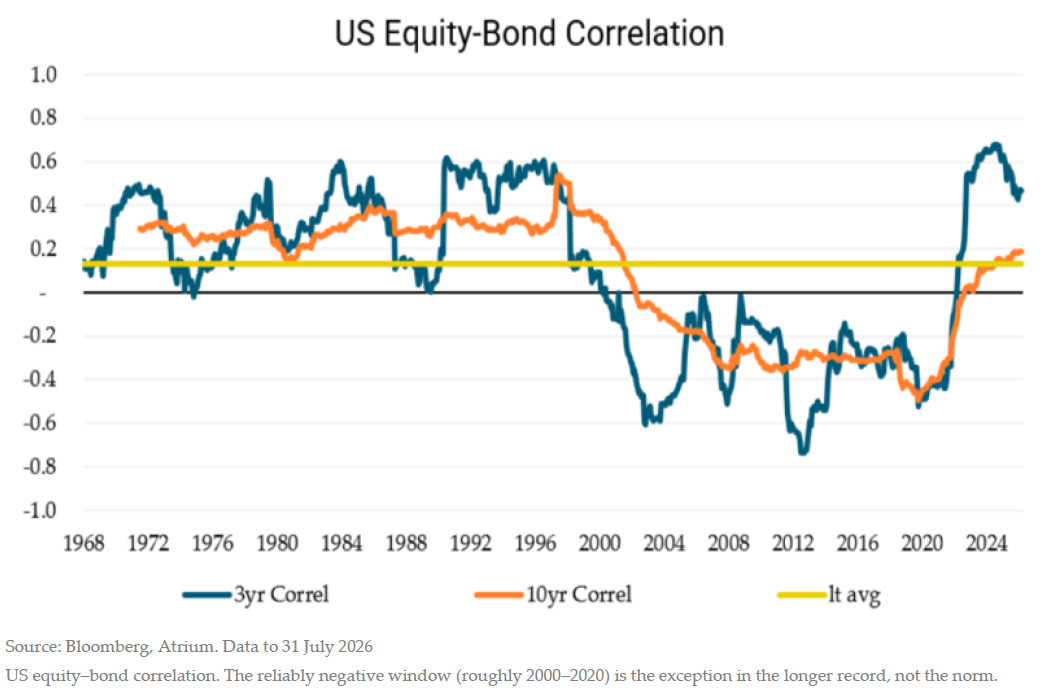
The longer history makes the point. The comfortable negative correlation between shares and bonds that portfolios were built around only really existed from about 2000 to 2020. Before that, for decades, they more often moved together, and since 2021 they have again. The negative correlation was the exception, and it lined up almost exactly with the low, stable inflation era. That is no coincidence: the inflation regime drives the relationship.
None of this means bonds are finished. They still have a genuine role, and in the right conditions remain an effective hedge you can own: if the next shock is a growth scare or a recession with inflation contained, bonds can rally hard. The mistake is to hold them passively and assume they protect in every environment. So we treat rate duration as an active decision, sized to the inflation backdrop and the point in the cycle rather than held at a fixed weight regardless of conditions.
Concentration, and why it matters for you
The second hole in the net is less obvious. Global equity indices have become extraordinarily concentrated. Inside the S&P 500, the ten largest companies made up around a fifth of the index before 2015; by 2025 that had doubled to more than 40%. The United States now accounts for around two-thirds of the global equity index, and the Magnificent Seven alone for close to a quarter of it.
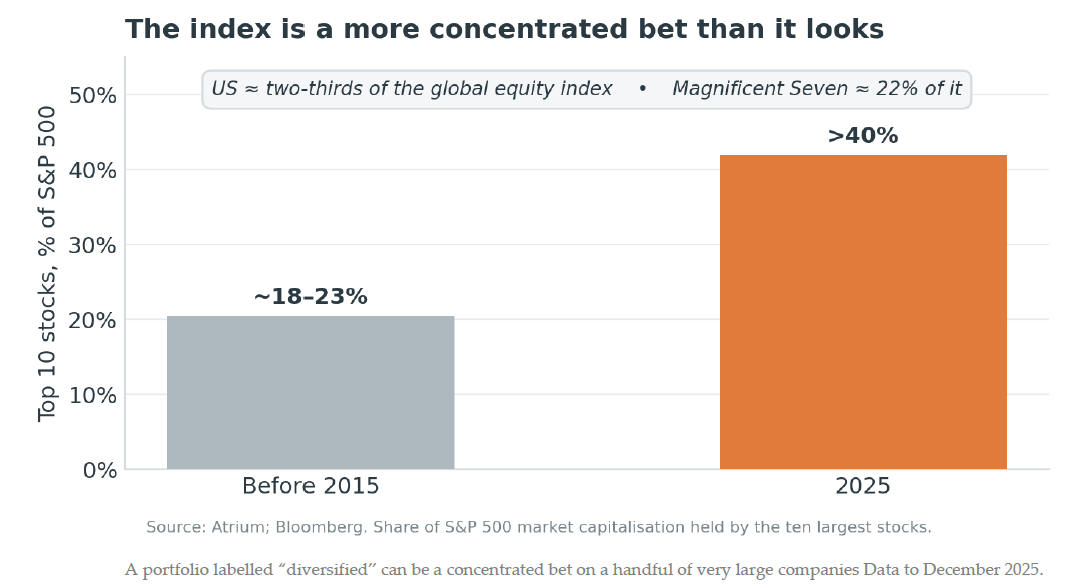
An investor in a global index fund would expect they own thousands of companies spread around the world. In reality, much of that money sits in a handful of very large US technology names sharing one theme, artificial intelligence, and the same drivers.
So the equity exposure is far less diversified than the label suggests; it carries more valuation risk, because those names are priced for a great deal of future success; and a shock to that single theme would hit the whole equity allocation at once rather than one corner of it. “Just holding the market” is no longer the broadly diversified exposure it once was; it has become an active, far more concentrated bet on a narrow set of companies.
How we have adapted to the shift in markets
If the ground is moving, we move with it, and one of the more important changes is in how we build the equity sleeve. For years we managed equity risk by backing high-quality active managers, on sound logic: good managers holding quality companies tended to hold up better in a downturn, giving a measure of built-in protection. That relationship has weakened. Active managers, especially in Australia and global large caps, have struggled to beat the index, and quality has not provided the cushion it used to, in part because equity concentration has repeatedly wrong-footed quality-focused managers.
So we have changed. We use less active management where repeatable alpha has become scarce, building the core efficiently with passive and systematic strategies, and run less concentrated exposure to any single manager. We no longer solely rely on quality managers to protect in a drawdown, and reserve active risk for where the edge is real and repeatable, such as small caps and emerging markets, and for diversified factor exposures rather than quality alone.
Genuine diversification, and why it is worth it
Genuine diversification means holding return streams driven by genuinely different things, so that when correlations spike inside shares or bonds, the portfolio still has engines running that are not connected to the shock.
That is why our Risk Targeted strategies invest globally across a wider set of specialist diversifiers:
- Liquid alternatives, whose returns come from distinct drivers that are low to negatively correlated with equities.
- Real assets and commodities, which benefit from the inflation dynamics that hurt bonds.
- Gold and currency diversification, which have historically steadied portfolios in geopolitical stress, and which central banks are themselves accumulating.
- Private markets, adding an illiquidity premium with its own return driver.
We use Liquid Alternatives to make the point. Allocating to this specialist asset class takes significant skill and a global opportunity set, because the returns are drawn from a wide range of strategies and managers rather than any single market.
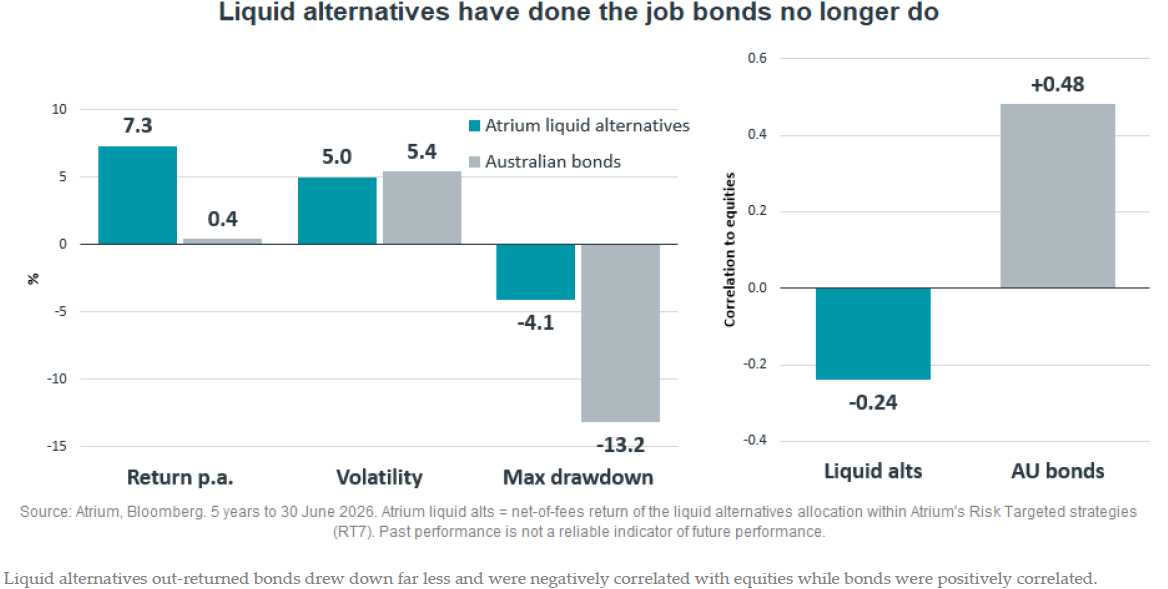
The numbers are compelling:
- Over the five years to June 2026, our liquid alternatives portfolio delivered 7.3% a year with volatility of 5.0% and a worst drawdown of just −4.1%.
- Over the same period, Australian bonds returned 0.4% a year with almost identical volatility of 5.4% and a far deeper worst drawdown of −13.2%.
Most telling is the correlation to equities at −0.24 for our liquid alternatives against +0.48 for Australian bonds.
These genuinely diversifying properties are why our Risk Targeted strategies hold ~15 to 25% in liquid alternatives as a core allocation, not a satellite, alongside active protection such as equity put options and currency overlays.
It matters all the more as geopolitical risk shifts from an occasional tail event to a recurring feature of the backdrop; Australia’s own Future Fund now calls geopolitics the bedrock of the new investment order. Where shocks recur rather than resolve, an uncorrelated return stream is valuable to own.
What this means for how we build portfolios
Put the pieces together and our positioning follows naturally. Everything serves one objective: delivering the return our clients require while actively managing the risk taken to achieve it. Today that leads us to:
- Hold a meaningful allocation to genuine diversifiers, including specialist liquid alternatives, real assets, gold and commodities, rather than relying on bonds to do a job the current inflation environment has taken from them.
- Treating bonds as an active decision, holding duration when the regime and the cycle say it will protect and sizing it down when it will not, rather than carrying a fixed weight regardless of conditions.
- Build the equity core more efficiently, with less reliance on active large-cap managers and a mix of passive and systematic strategies, while reserving the active fee budget for selective markets where the edge is still real.
- Size our exposure to the big US technology names to what our risk budget supports, not to what the index dictates. We are market-aware, not benchmark-bound.
- Layer active protection, equity puts and currency overlays, on top, to help smooth returns so a sharp event-driven drawdown does not undo the long-term plan.
- Keep the freedom to move. We are not bound by the Your Future, Your Super performance test, and are not so large that scale prevents us shifting meaningfully across asset classes when the opportunity set changes.
The result is a portfolio that owns genuine diversification by design rather than by label. This does not mean avoiding every bout of volatility; no sensible approach can, and at times we will deliberately hold risk through short-term ructions.
What it aims to deliver is a smoother path of returns and lower volatility over the long term, drawing down less when a traditional diversified portfolio draws down most. For many investors, that smoother path matters as much as the destination.
None of this is cause for fear, but it does call for a considered response.
As always, we do not try to predict the next headline, the portfolios own the medium-term view, and we manage them actively to maximise the probability that risk and return objectives are met whatever the backdrop delivers.
Tony Edwards, Chief Investment Officer